The Junior Paradox in the AI Era
AI eliminated the tasks juniors used to learn on. The role didn't go away — but the runway did. Part 1 of a series on mentoring juniors when execution is cheap and decisions are everything.
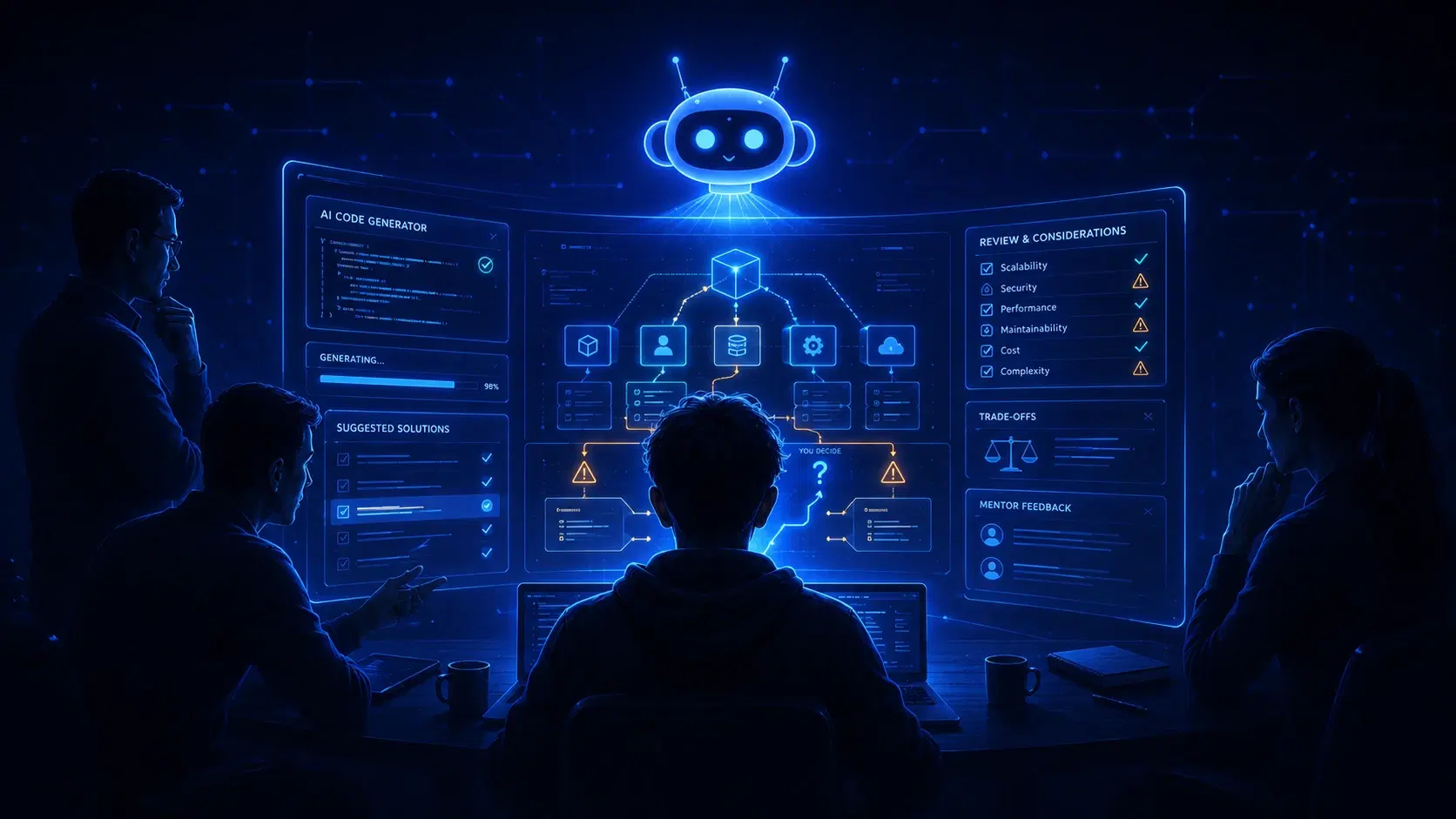
The Junior Paradox in the AI Era
Part 1 of 3 — a series on mentoring juniors in the AI era
There was a time when juniors had the right to be slow.
They wrote boilerplate. Built CRUD endpoints. Added tests to existing code. Did the mechanical refactors no one wanted to touch.
These tasks weren't glamorous. They didn't make it into presentations. They didn't build impressive portfolios.
But they had one enormous value: they gave time.
Time to stumble. Time to debug. Time to understand the framework. Time to see how technical decisions actually play out — not just in theory.
Today, this layer of work is disappearing.
And that's not entirely good news.
For years, the path into the profession was fairly predictable. A junior's first months on the job usually revolved around repetitive, relatively safe tasks: endpoints, DTOs, forms, tests, small fixes, simple integrations, refactors.
From the business side — cheaper to hand it to a junior than a senior. From the junior's side — a chance to learn the fundamentals while delivering real work.
And that "while" was the key part.
Writing yet another simple endpoint, a junior wasn't just producing code. They were learning where the framework breaks. How to read errors. How to debug. What a good API contract looks like. Why one pattern beats another. How to make sense of someone else's decision from a year ago.
It was informal education embedded in the tasking.
AI disrupted that setup.
Copilot, Claude, Cursor and similar tools generate boilerplate in seconds. CRUD is no longer "an easy task for the junior." Increasingly, it's a command in a chat window.
And that's where the paradox begins.
The tasks juniors used to learn the trade on are vanishing — or losing the educational value they used to have. But the junior role itself isn't going anywhere.
It's just that today, you enter it on harder terms.
Because if execution itself is getting cheaper, the bar moves elsewhere.
It's no longer enough to "write an endpoint." You need to know what endpoint should be built. What contract makes sense. How to handle errors. Where to draw the responsibility line. Whether this integration should even look like this in the first place.
These are decisions you used to grow into.
After a year of watching code reviews. After dozens of architectural discussions. After a few production incidents. After seeing seniors break problems down to first principles.
Today, a junior is expected to be close to that conversation almost from the start.
And that's a problem.
Not because juniors are worse than they used to be. They're not.
They've just entered a different game.
And decisions can't be learned through code generation alone.
There's a second shift — in my view, even more important.
Today's junior has to master a skill that many seniors never formally taught, because they picked it up through years of practice:
when not to trust AI.
It sounds simple. It isn't.
To notice that AI generated something off, you need intuition. You need to know what code that "compiles but is wrong" looks like. You need to feel when a solution is too generic, too brittle, or doesn't fit the system's context.
A senior often sees it in seconds.
A junior, not yet.
And it's hard to hold that against them.
The trouble starts when a junior treats AI output as an endpoint instead of a starting point. Pastes the code into the PR, gets review comments, fixes them, moves on.
Best case — they learn. Worst case — they just remember that "the senior said to change it."
That doesn't build intuition.
The old junior wrote bad code on their own and learned why it was bad. Today's junior can accept bad code generated by AI and still not understand why it's bad.
That's not the same learning path.
Which is why mentoring a junior in the AI era can't just be about handing them a task, doing the review, and expecting them to "figure it out."
That stops working.
We have to teach more deliberately.
Not just: "write this function." But: "let's look at the possible approaches." Not just: "AI generated some code." But: "let's check where this code might be lying." Not just: "fix the PR." But: "let's talk about where this fix comes from."
Juniors today don't just need tasks. They need calibration.
How to judge an AI's response. How to ask the right follow-up questions. How to verify assumptions. How not to mistake speed for quality. How to tell syntactically correct code from architecturally sensible code.
This changes the role of seniors and tech leads.
Most of us were mentored under the old model. We learned through repetition, through exposure, through watching more experienced people make decisions.
Now we often try to recreate that same model, but the environment isn't the same anymore.
We hand a junior a task that used to teach fundamentals and wonder why it doesn't produce the same effect today.
Because that task now works differently.
If a junior uses AI, it's no longer enough to evaluate just the final code. We also have to teach the process of getting there.
That might mean more pair programming. It might mean reviewing prompts and AI responses together. It might mean checklists for verifying generated code. It might mean tasks designed not only for delivery, but for building intuition.
AI can be a great learning tool.
But only if someone teaches them to question it — and almost no one is teaching that today.
Because the 2026 junior isn't worse than the 2019 junior.
They just don't have the same runway anymore.
And if the industry is taking the safe learning space away from juniors, it has to deliberately build a new one.
Otherwise, in a few years, we'll wake up to a generation of programmers who can generate code very fast — but don't know when that code makes sense.
And that won't be a failure of the juniors.
It will be a failure of our mentoring.
Next in the series: what AI fundamentally cannot teach a junior — and why that changes what we have to teach.
Was this helpful?